Local SEO Sydney small business success starts with being visible when nearby customers search for your products or services. You may have a great offering and loyal customers, but if your business doesn’t appear in local search results, your competitors are the ones winning those valuable enquiries.
This is one of the most common frustrations for Sydney small businesses in 2026. The good news is that this can be fixed.
Google data suggests that approximately 46% of all searches have a local focus, highlighting the importance of local SEO for businesses. And research from BrightLocal shows that 76% of people who search for a nearby business visit within 24 hours. If your business isn’t visible in local search, you’re missing a large portion of customers who are already ready to act.
Local SEO for Sydney small businesses is not about gaming Google. It’s about making sure the right people can find you when they’re ready to buy, book, or call. This guide will walk you through exactly how to do that, from setting up your Google Business Profile the right way to building suburb-specific pages that bring in real enquiries.
Whether you run a trades business in Parramatta, a health clinic in the Inner West, or a retail store in Bondi, this guide is for you.
What Is Local SEO and Why Does It Matter for Sydney Small Businesses?
Local SEO is the process of improving how your business appears in location-based searches on Google. When someone types “electrician near me” or “dentist Surry Hills”, Google shows them local results based on where they are. Local SEO helps make sure your business shows up in those results.
Local SEO vs Traditional SEO
| Traditional SEO | Local SEO | |
| Audience | National or global | Local customers nearby |
| Rankings target | Organic blue-link results | Google Maps + local results |
| Keywords | Broad, location-agnostic | Geographic + service keywords |
| Key signals | Domain authority, content | Google Business Profile, reviews, citations |
| Best for | Online businesses | Shops, trades, services, clinics |
For Sydney businesses, this distinction matters a lot. A plumber in Parramatta doesn’t need to rank for “plumber Australia”. They need to rank for “plumber Parramatta” or “emergency plumber Western Sydney”. That’s where local SEO delivers real value.
The stakes are high. Most people searching for a local service on their phone make a decision within 24 hours. If you’re not visible, that call goes to someone else.
Google Maps, Google Business Profile, and local search results are now the front door for most Sydney businesses. Local SEO makes sure that front door is open and easy to find.
In short, Local SEO helps Sydney small businesses connect with nearby customers by improving their visibility in relevant Google search results.
It focuses on Google Maps visibility, Google Business Profile optimisation, and location-based keywords, rather than competing for broad national rankings.
How Google Maps Rankings Work in 2026
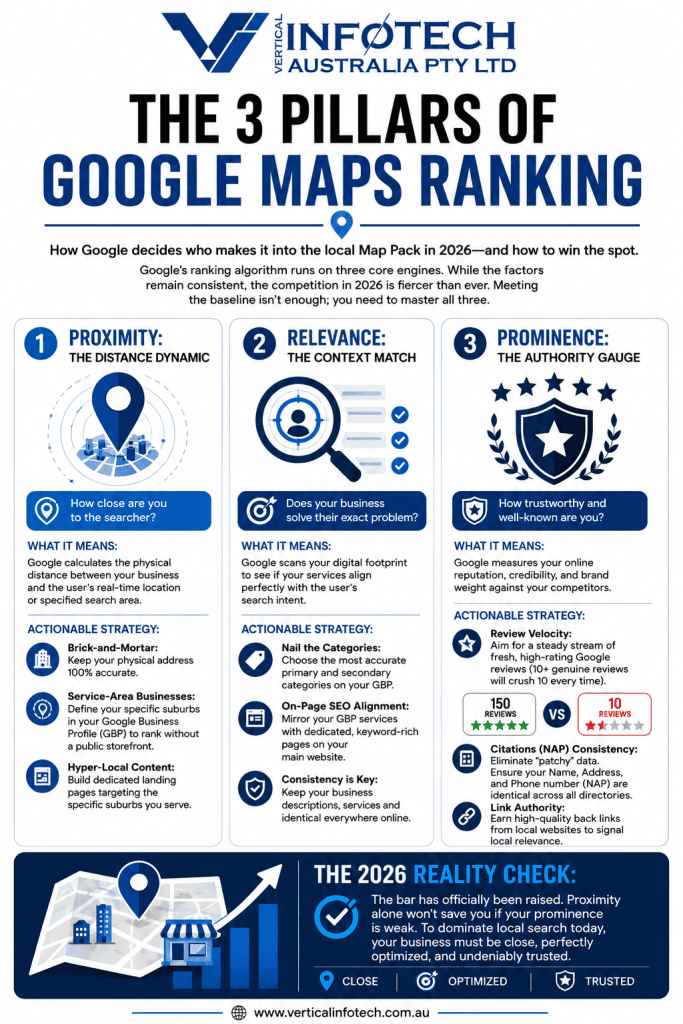
When you search for a local service, Google often shows a group of three businesses at the top of the results. This is called the Map Pack, or the local 3-pack. Appearing here is the single most important goal for most Sydney small businesses.
What Are the 3 Google Maps Ranking Factors?
Google uses three primary factors to determine which businesses appear in the Map Pack:
- Proximity – How close the business is to the searcher
- Relevance – Measures how well a business satisfies the needs expressed in a user’s search.
- Prominence – Reflects a business’s popularity, credibility, and overall visibility.
Here’s what each one means in practice.
Proximity
Proximity reflects the physical distance between your business and a potential customer. Google takes into account the searcher’s location, your business address, and the service areas defined in your Google Business Profile when determining local search rankings.
If you’re a plumber based in Chatswood, you’re more likely to appear when someone in Chatswood searches than someone in Cronulla. But you can influence this by setting your service areas correctly in your Google Business Profile and by creating content that targets the suburbs you actually serve.
For service-area businesses (like mobile tradies, cleaning companies, or mobile dog groomers), proximity works differently. You can set your service area without displaying a physical address, and Google will factor that in.
Relevance
Relevance is about how well your business matches what the person searched for. Google looks at your business category, your service descriptions, the keywords on your website, and the content of your Google Business Profile.
If someone searches “Italian restaurant Newtown” and your Google Business Profile is categorised correctly, mentions Italian cuisine in the description, and your website has pages about Italian food, Google sees your business as highly relevant to that query.
This is why it’s important to be specific and accurate about what you do, not just in one place, but everywhere your business appears online.
Prominence
Prominence is about trust and authority. Google assesses how established, trustworthy, and well-known your business appears to potential customers online. This includes your Google reviews (how many you have, how recent they are, and what rating you hold), links from other websites pointing to yours, local citations across directories, and your overall online presence.
A business with 150 genuine Google reviews, a solid website, and consistent details across the web will almost always outrank a business with 10 reviews and patchy information, even if they’re the same distance from the searcher.
These three factors are the engine behind every Google Maps ranking. The strategies in this guide are all designed to strengthen one or more of them.
Although Australia’s local search ranking factors have remained relatively consistent in 2026, the competition for local visibility has become increasingly intense. With more businesses investing in local SEO, achieving strong local visibility now requires greater effort and strategy. That means the bar is higher, and the basics alone are no longer enough.
Key Takeaways
- The Map Pack shows the top 3 local businesses for any location-based search
- Google ranks these businesses on proximity, relevance, and prominence
- All three factors need to be optimised together for consistent visibility
- Competition in Sydney has increased, so doing the basics is no longer enough
Google Business Profile Optimisation Sydney: The Foundation of Local SEO
Your Google Business Profile (GBP) is your most important local SEO asset. It’s free. It’s powerful. And most businesses are using it at about 20% of its potential.
A fully optimised Google Business Profile tells Google exactly who you are, what you do, where you do it, and why customers trust you. Here’s how to get it right.
How to Optimise a Google Business Profile: Step by Step
Step 1: Verify ownership Claim your Google Business Profile at business.google.com and complete the verification process. Without verification, your profile won’t rank.
Step 2: Choose the right categories Select the most accurate primary category first. This is one of the most important fields for relevance. You can add secondary categories too. Be specific. “Electrician” is better than “Contractor” if that’s what you do.
Step 3: Complete every detail Fill in every available field:
- Business name (use your actual business name only—avoid keyword stuffing or promotional additions).
- Full address matching your website and directories exactly
- Local phone number
- Website URL
- Services with descriptions (this content is indexed by Google)
- Business description of around 250 words including your location and key services naturally
Step 4: Upload quality photos Businesses with photos receive significantly more clicks and direction requests than those without. Enhance your profile by uploading photos of your team, office or storefront, completed project results, and company logo.
Step 5: Request reviews Set up a system to ask happy customers for reviews. We’ll discuss this in more detail in the reviews section below.
Step 6: Publish Google Posts on a regular basis
Keep your Google Business Profile active by sharing promotions, announcing new services, and providing valuable tips or updates for your audience. Regularly publishing updates helps signal to Google that your business profile is active, current, and well maintained.
Step 7: Maintain accurate opening hours Update your hours for public holidays, seasonal closures, and any schedule changes. Google allows you to set special business hours for specific dates, ensuring customers see accurate opening times during holidays and other events. Incorrect hours are a common trust-killer.
A properly optimised Google Business Profile works best when paired with a professionally designed website that is fast, mobile-friendly, and locally relevant.
Google Business Profile optimisation in Sydney is not a one-time task. It’s an ongoing part of running your online presence.
In Short: Your Google Business Profile is the single most important local SEO asset for any Sydney business. Complete every field, choose accurate categories, upload quality photos, publish regular posts, and maintain correct hours. Combine it with a fast, well-structured website for maximum impact.
How to Rank on Google Maps Australia: Proven Strategies
Beyond your Google Business Profile, there are several strategies that consistently move the needle for Australian businesses targeting local search.
Build NAP Consistency
NAP refers to your business’s Name, Address, and Phone Number—the essential contact information that should remain accurate and consistent across all online listings. These three details need to be identical everywhere they appear online.
That means your website footer, your Google Business Profile, Facebook page, LinkedIn, Yellow Pages listing, and every other directory where your business is listed. Even small differences, like “St” versus “Street”, or a different phone number format, can confuse Google and weaken your local rankings.
Do a quick audit. Search your business name on Google and check the top results. Are your details consistent? If not, fix them one by one, starting with the most authoritative platforms.
Build Local Citations
A citation is any online mention of your business name, address, and phone number. Strong local citations help Google verify that your business is legitimate and located where you say it is.
Key directories for Australian businesses include:
- True Local Australia: One of Australia’s most trusted local directories.
- Yellow Pages Australia: Still heavily used and trusted by Google.
- Yelp Australia: Particularly relevant for hospitality and services.
- Bing Places: Don’t forget Microsoft’s local platform.
- Apple Maps: Millions of Australians use Apple devices for navigation.
- Facebook Business: Your social profile counts as a citation.
Industry-specific directories matter too. A medical clinic should be on HealthEngine. A builder should be on Houzz. A restaurant should be on Zomato. Think about where your customers look, and make sure your business is there with accurate details.
Earn Quality Local Backlinks
Backlinks are incoming links from other websites that direct users to your website. For local SEO, the quality and local relevance of these links matters more than the quantity.
Some practical ways to earn local backlinks in Sydney include:
- Joining your local chamber of commerce (most publish member directories).
- Sponsoring a community event, sports team, or local charity.
- Getting listed on industry association websites.
- Contributing an expert comment or article to a local news website or blog.
- Partnering with complementary businesses for referrals and co-mentions.
A carpet cleaner in Hurstville who gets a mention on the local community Facebook page, a link from a local real estate agent’s “recommended services” page, and a listing on the Inner South Sydney chamber website is building real local authority. That’s how to rank on Google Maps in Australia for the long term.
Key Takeaways
- NAP consistency across all platforms is foundational for local rankings
- Prioritise quality local citations over bulk directory submissions
- Local backlinks from Sydney-based sources carry strong authority signals
- Industry-specific directories are often more valuable than general ones
The Power of Reviews in Local SEO
Reviews are one of the most direct ways to improve your Google Maps ranking. They also happen to be one of the most powerful ways to win customers.
According to findings from BrightLocal, 98% of consumers rely on online reviews when researching local businesses. A business with a 4.8 star rating and 120 reviews will almost always out-click a competitor with a 4.2 rating and 15 reviews, even if both appear in the same search results.
Here’s what Google considers when weighing reviews: the total number of reviews, your average rating, how recent your reviews are, and how you respond to them.
Real Example: How Reviews Changed the Game for a Sydney Electrician
Consider a Sydney electrician servicing the Western Suburbs who had just 12 Google reviews after four years in business. After implementing a simple follow-up text system asking customers for feedback right after job completion, they collected 40 new reviews in three months. Their Google Business Profile calls increased noticeably, and they began appearing in the Map Pack for searches in Parramatta, Blacktown, and Penrith, suburbs where they previously had no visibility at all.
The strategy wasn’t complicated. It was consistent.
Building a Review Generation Strategy
The businesses that do reviews well don’t wait for customers to leave them. They have a system.
The best time to ask for a review is right after a positive experience, while the customer is still happy. This could be:
- A follow-up text message sent the same day as a job completion.
- A follow-up email 24 hours after service delivery with a direct link to your Google review page.
- A short card handed to the customer at the end of a visit that says “Happy? Tell Google.”
Make it easy. A direct link to your Google review page removes friction. The more steps a customer has to take, the less likely they are to follow through.
Be consistent. Ten reviews a month is better than 120 reviews in one month and nothing for the next year. Google rewards fresh, ongoing review activity.
Review Response Best Practices
Respond to every review. Every single one.
When replying to positive reviews, a brief and genuine thank-you can help reinforce customer trust and appreciation. You can also mention the specific service or location to reinforce local relevance. “Thanks so much for trusting us with your bathroom renovation in Leichhardt, Alex. Really glad you’re happy with the result.”
For negative reviews, stay calm and professional. Acknowledge the issue, apologise if appropriate, and offer to resolve it offline. Never argue. Never be defensive. A well-handled negative review can actually build more trust than a page full of five-star ratings with no responses, because it shows you’re a real business that cares.
In Short: Reviews are both a ranking signal and a conversion driver. Build a simple, consistent system to ask for reviews after every job. Respond to all reviews, positive and negative. Fresh, genuine review activity is more valuable than a one-off burst.
Local Landing Pages and Suburb Targeting Sydney
If your business serves multiple suburbs across Sydney, a single generic “SEO services Sydney” page will not cut it in 2026.
Suburb targeting means creating dedicated pages on your website for each key location you serve. These pages help Google understand exactly where you work and what you offer in each area. They also match the specific search queries your local customers are using.
Examples of suburb-targeted pages that work well:
- Website Design Parramatta
- SEO Services Inner West
- WooCommerce Development Sydney CBD
- Plumber Chatswood
- Accountant Bondi Junction
Each of these pages should be unique. Don’t just copy the same content and swap the suburb name. Google can detect thin, templated content and it won’t rank.
Instead, each suburb page should include:
- A description of how you serve that specific area.
- Any relevant local context (popular streets, landmarks, common local needs).
- Testimonials or case studies from clients in that suburb, if you have them.
- Your contact details and a clear call to action.
- Internal links to your main SEO service pages and website development services.
Suburb-specific pages combined with a well-optimised Google Business Profile is one of the most effective strategies for dominating local search across multiple Sydney areas.
Key Takeaways
- Generic “Sydney” pages are not enough for suburb-level visibility
- Each suburb page needs unique, locally relevant content
- Include local context, testimonials from that area, and clear calls to action
- Never create duplicate suburb pages with only the location name swapped
Businesses looking to strengthen their local search presence often benefit from professional SEO guidance and technical website optimisation, particularly when they’re targeting multiple Sydney suburbs.
Schema Markup and Technical Local SEO
Technical SEO is the foundation everything else sits on. A brilliant Google Business Profile and 200 five-star reviews won’t fully deliver results if your website is slow, hard to use, or technically broken.
LocalBusiness Schema
Schema markup is code you add to your website to help Google understand your business information in a structured way. LocalBusiness schema tells Google your business name, address, phone number, opening hours, and service area in a format it can easily read.
When your schema matches your Google Business Profile and your website content, Google gains more confidence in your business information. This can improve your visibility in local search results and help your details appear correctly in Google’s knowledge panels.
You don’t need to code this yourself. Most modern websites and WordPress plugins can generate this automatically. But it’s worth checking that it’s set up correctly. You can verify your schema using Google’s Rich Results Test tool at search.google.com/test/rich-results.
Key entities to declare in your LocalBusiness schema:
- Business name, address, and phone number
- Opening hours and special hours
- Service area or geographic area served
- Business type and categories
- Website URL and social profiles
Website Technical Factors
Before any of the more advanced local SEO strategies will fully work, your website needs to be technically sound. The key factors are:
- Mobile friendliness: More than half of all local searches in Australia happen on a mobile phone. If your site doesn’t work well on a small screen, you’re losing customers and rankings.
- Page Speed: Google assesses the time it takes for your pages to load and deliver content to visitors. A slow site frustrates users and is penalised in rankings. Tools like Google PageSpeed Insights and Google Search Console can show you where you stand.
- HTTPS Security: Your website should use a valid SSL certificate to maintain a secure HTTPS connection and protect visitor data. This is a basic trust signal that Google expects.
- Core Web Vitals: Google measures real-world user experience metrics including how quickly your page loads, how stable the layout is, and how quickly it becomes interactive. These are ranking factors.
Many small business websites in Sydney are running on slow, outdated platforms or poorly-built themes. A fast, well-structured custom-built website can be the difference between sitting in position seven and appearing in the Map Pack.
Ongoing website maintenance also plays a role here. A site with broken links, outdated plugins, or security vulnerabilities can see rankings drop quietly over time.
In Short: LocalBusiness schema helps Google understand your business as a trusted local entity. Combined with a fast, mobile-friendly, technically sound website, schema markup reinforces every other local SEO signal you’re building.
Local SEO Mistakes Sydney Businesses Should Avoid
Here are the most common mistakes that hold Sydney businesses back on Google Maps:
Inconsistent NAP details. If your address on Google says “Level 2, 15 Smith Street” but your website says “15 Smith St, Level 2”, these look different to an algorithm. Audit and standardise your details everywhere.
Keyword stuffing on your Google Business Profile. Adding phrases like “best plumber cheap plumber Sydney plumber near me” to your business name or description will get your profile suspended, not promoted.
Fake reviews. Buying reviews or asking friends to leave fake ones is against Google’s guidelines. When Google detects this (and it increasingly does), your profile can be penalised heavily.
Thin or duplicate suburb pages. Creating 20 suburb pages by copying the same content and swapping the suburb name is a red flag to Google. Every page should provide unique, relevant, and valuable content that meets the needs of its intended audience.
Ignoring Google Business Profile updates. If your hours change, your phone number changes, or you move premises, update your profile immediately. Outdated information costs you customers and rankings.
Poor mobile experience. A website that looks great on desktop but breaks on mobile is a liability. Test your site on multiple devices regularly.
One-off optimisation with no follow-through. Local SEO is not a “set and forget” task. Search algorithms are regularly updated, competitors continue to improve their strategies, and your business evolves over time, making ongoing optimisation essential.Ongoing attention is required to maintain and grow rankings.
Local SEO Trends for Australia in 2026
The local SEO landscape in Australia continues to evolve. Here’s what’s shaping rankings and search behaviour in 2026.
Zero-Click Searches
More and more searches are being answered directly on the Google results page, without the user clicking through to any website. Google shows your business hours, phone number, reviews, and even FAQ answers right in the search results.
This sounds bad for websites, but it’s actually a reason to invest more in local SEO. A fully completed and optimised Google Business Profile can help your business gain exposure in search results, even when users don’t visit your website. Every time someone calls you directly from a Google result, that’s a zero-click win.
AI-Powered Search Results
Google’s AI Overviews are now appearing for many local and informational searches. These are AI-generated summaries at the top of the results page that draw from trusted local sources.
To appear in AI Overviews, your content needs to be clear, factual, well-structured, and authoritative. Businesses that have invested in well-written, locally relevant content are the ones being cited in these AI summaries. Structuring content with clear definitions, step-by-step sections, and direct answers to common questions significantly improves your chances of being cited by AI search tools like ChatGPT, Gemini, and Perplexity.
Voice Search Growth
Voice search is growing steadily in Australia. People ask their phones questions like “What’s the best web designer near me?” or “Find a plumber open now in Sydney”.
Voice search results are heavily influenced by local SEO signals. Businesses that rank well in Google Maps tend to be the ones voice assistants recommend. Structuring your content around natural language questions and concise, helpful answers can improve its relevance for both users and search engines.
These local SEO Australia 2026 trends all point in the same direction: businesses that invest in genuine, well-maintained local SEO will continue to pull ahead of those who do the basics and stop there.
Key Takeaways
- Zero-click searches make Google Business Profile optimisation more valuable than ever
- AI Overviews pull from clear, well-structured, authoritative content
- Voice search favours businesses with strong local SEO signals
- Conversational, question-and-answer content structure improves AI visibility
How Vertical Infotech Helps Sydney Businesses Grow Online
Vertical Infotech is a digital marketing and technology agency headquartered in Sydney, supporting Australian businesses in growing their online footprint.Based in Hurlstone Park, NSW, they work with local businesses to deliver practical, results-focused digital solutions.
Their core services include:
Custom Website Development: Vertical Infotech specialises in building high-performance websites from scratch, with a strong focus on WordPress and WooCommerce. Unlike template-based solutions, custom-built websites offer better flexibility, faster performance, and stronger support for long-term business growth.
Website Design: Every site they build prioritises speed, function, and a seamless experience across all devices. A well-designed, responsive website is not just good for users; it’s a foundational requirement for local SEO.
Website Maintenance: Ongoing support, security updates, and performance monitoring keep your site running well and secure. An outdated or poorly managed website can undermine both your SEO performance and customer trust.
SEO and Digital Marketing: From Google Business Profile optimisation to suburb-level content strategies, their team executes the kind of targeted, local-first SEO that actually moves the needle for Sydney businesses.
What sets Vertical Infotech apart is their Sydney-based local knowledge combined with a focus on scalability and sustainable growth. They understand what it takes to compete in Sydney’s crowded local search landscape, not from a textbook, but from working with businesses across the city.
If you’re looking for a team that understands both the technical side of websites and the nuances of local SEO in Sydney, they’re worth speaking to. You can reach them at +61 477 577 050 or visit them at 13 Starkey St, Hurlstone Park, NSW 2193.
Conclusion: Local SEO Is a Long Game Worth Playing
Local SEO for Sydney small businesses comes down to a few core principles, done consistently and done well.
Start with your Google Business Profile. Get every detail right. Keep it updated. Collect reviews and respond to them.
Build NAP consistency. Make sure your business name, address, and phone number are accurate everywhere online. Fix the inconsistencies. Add your business to the right local directories.
Invest in your website. A fast, mobile-friendly, well-structured site is not optional. It forms the foundation that supports every other aspect of your strategy.
Create locally relevant content. Build suburb pages, write locally focused articles, answer the questions your customers are actually asking.
Use schema markup. Help Google understand your business information clearly and consistently.
Track and improve. Use Google Search Console, Google Analytics (GA4), and your Google Business Profile insights to see what’s working and where to focus next.
None of this is complicated. Success doesn’t happen overnight. Local SEO requires ongoing effort, consistency, and attention to detail. Rather than being a one-off project, it’s a long-term investment that helps your business remain visible to the right audience when they’re searching for your products or services.
The Sydney businesses securing top positions in Google Maps aren’t always the largest or highest-spending competitors—they’re often the ones that consistently invest in effective local SEO. They’re the ones that have built strong, consistent, trustworthy local signals over time.
If you’re looking to improve your local visibility and attract more qualified enquiries, partnering with an experienced Sydney SEO and web development team can help you achieve sustainable, long-term growth.
Frequently Asked Questions
Local SEO is the practice of optimising your online presence to improve visibility in search results for users looking for products or services in a specific location. When someone searches for a product or service near them, local SEO determines which businesses appear in Google Maps and the local search results. It involves optimising your Google Business Profile, building local citations, earning reviews, and creating locally relevant website content.
Most Sydney businesses begin to see early movement in local search results within three to six months of implementing a proper local SEO strategy. Significant, stable improvements typically take six to twelve months depending on how competitive your industry and suburb are. Local SEO is an ongoing investment, not a quick fix, and results compound over time as your online presence strengthens.
Google determines which businesses appear in Google Maps results based on three factors: proximity (how close the business is to the searcher), relevance (how well the business matches the search query), and prominence (how well-known and trusted the business appears based on reviews, citations, and links). Optimising all three factors is essential for consistent Google Maps visibility in Sydney.
Google reviews influence both rankings and conversions. Google uses review volume, rating, recency, and how owners respond as signals of business quality and relevance. More importantly, customer reviews help build trust and credibility with potential customers, making them more likely to choose your business. A business with many genuine, recent reviews is more likely to receive calls and enquiries than one with few reviews, even if both appear in the same search results.
NAP refers to a business’s Name, Address, and Phone Number—the key details that should remain consistent across all online listings. NAP consistency means ensuring these three details are identical everywhere your business appears online, including your website, Google Business Profile, and all directory listings. Inconsistent NAP data confuses search engines and can suppress your local rankings. Regular audits and corrections are an important part of any local SEO strategy.
Yes. Businesses that travel to customers (such as electricians, mobile cleaners, or photographers) can benefit from local SEO without displaying a physical address. You can set service areas in your Google Business Profile, create suburb-specific landing pages on your website, and build local citations that reflect the areas you serve. Google understands and supports service-area businesses in local search results.

Australian web design and SEO agency. Since 2015, we’ve built and optimised hundreds of websites for local tradies, ecommerce brands, and professional services businesses across NSW and VIC.