
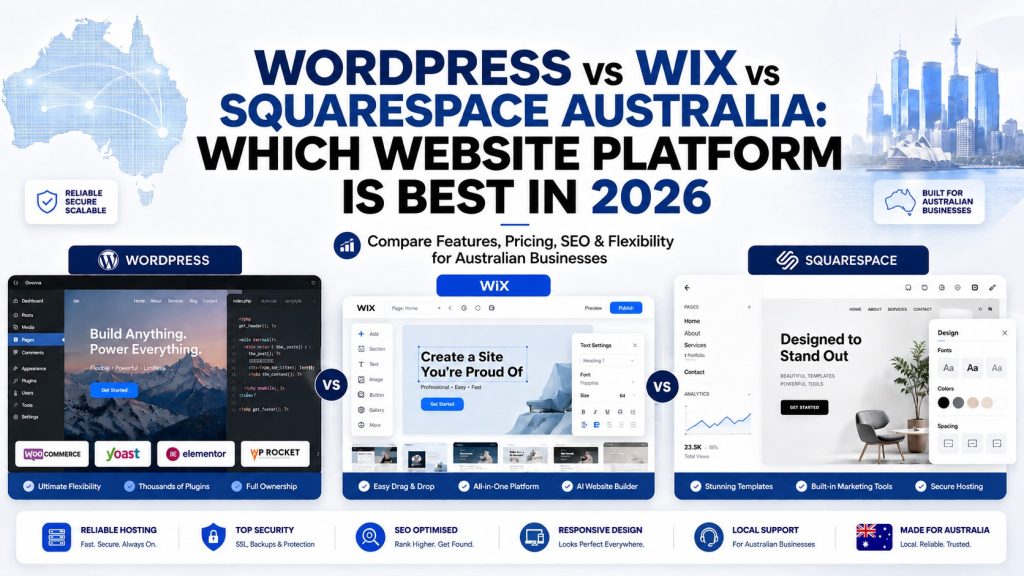
Why Your Website Platform Matters More Than You Think
Most Australian businesses don’t realise their website platform becomes difficult and expensive to change later. What feels like a cheap decision today can turn into a full rebuild within two years — new costs, lost SEO
progress, and weeks of disruption to your business.
Table of Contents
ToggleWhether you’re a tradie in Western Sydney, a café owner in Melbourne, or an ecommerce startup scaling across Australia — the platform you pick shapes your Google rankings, your ability to grow, and your long-term costs
The platform you choose affects:
• SEO performance — how easily Google can find, crawl, and rank your pages
• Page speed — a direct Google ranking factor and key driver of user experience
• Control and ownership — whether you own your site or are renting it
• Scalability — whether your site grows with your business or becomes a bottleneck
• Ecommerce capability — your ability to sell with Australian payment solutions
• Long-term costs — what you’ll actually spend over three to five years
WordPress Explained
WordPress is an open-source content management system (CMS) that powers over 43% of all websites on the internet — from local tradies to global enterprises. When professionals refer to WordPress, they mean WordPress.org — the self-hosted version that gives you complete control over your site.
WordPress Pros
• You own your website completely. It lives on your hosting server — not a platform company’s infrastructure.
• Unlimited customisation. Access to thousands of themes and over 59,000 plugins covering SEO, booking, CRM, ecommerce, and more.
• For businesses that want a custom WordPress website in Australia, this level of flexibility is unmatched — no two builds need to look or function the same.
• Advanced SEO control. Full management of URL structures, heading hierarchy, schema markup, and page speed — all direct ranking factors.
• WooCommerce for ecommerce. The world’s most flexible ecommerce plugin, with native Afterpay, Zip Pay, and Australia Post integrations.
• True scalability. WordPress powers sites with 5 pages and sites with 50,000 pages — same platform, same control.
• Local SEO advantages. Suburb and city-level targeting, Google Business Profile integration, and custom local schema markup.
WordPress Cons
• Steeper learning curve than drag-and-drop builders
• Requires hosting, security, and plugin update management — or a professional agency
• A poorly built WordPress site can underperform a well-set-up Wix site
Wix Explained
Wix is a cloud-based drag-and-drop website builder designed for beginners. It lets you launch a basic site quickly without coding knowledge, using pre-designed templates and AI-assisted design tools.
Wix Pros
- ● Very beginner-friendly — no technical skills needed
- ● Hosting, security, and SSL are handled by Wix
- ● Fast setup — you can launch in a day
- ● Predictable monthly pricing for early-stage businesses
Wix Cons — Where Wix’s Limitations for Business Become Real
- ● Wix SEO problems. Despite improvements, Wix still produces bloated code that slows page loading — a confirmed Google ranking factor. URL structures and technical SEO controls are more limited than WordPress.
- ● Template lock. Choose a Wix template and you’re stuck with it. Changing design later means starting over from scratch.
- ● Limited scalability. When it comes to Wix vs WordPress scalability, the gap becomes obvious the moment a business starts growing beyond basic pages and contact forms.
Squarespace Explained
Squarespace is an all-in-one website builder known for its premium, design-forward templates. It handles hosting, security, and basic ecommerce out of the box — everything in one subscription.
Squarespace Pros
● Beautiful, award-winning templates designed to impress from the start
● Clean, structured editing experience
● All-in-one — hosting, SSL, and basic features in one plan
Squarespace Cons
● More restrictive than WordPress — limited customisation options
● Far fewer third-party integrations
● Like Wix, it locks you into its ecosystem
● Limited advanced SEO capabilities for competitive Australian keywords
Platform Lock-In: The Risk Most Australian Businesses Miss
Wix and Squarespace are closed systems. You’re effectively renting your website from them. This creates a specific risk that catches many business owners off guard:
“When you outgrow a closed platform, you can’t take your site with you. You rebuild from scratch — losing years of SEO signals, your URL structure, and months of time. It’s one of the most common and costly mistakes we see Australian businesses make.”
On both Wix and Squarespace:
● You cannot export and migrate your site — you must rebuild entirely
● If the company changes pricing or shuts down, you have no fallback
● Your customer data and site structure are governed by their terms
● Any SEO equity you’ve built is tied to their infrastructure
WordPress is open-source. You can move hosts, change agencies, or take your site to any developer — your website truly belongs to you.
Website Builder Comparison Australia: WordPress vs Wix vs Squarespace Full Breakdown
To help you identify the best website builder for Australia in 2026, here’s how WordPress, Wix, and Squarespace stack up across the factors that matter most to local businesses.
| Factor | WordPress | Wix | Squarespace |
|---|---|---|---|
| SEO control | Excellent (full control) | Moderate | Basic |
| Ease of use | Moderate | Very easy | Easy |
| Scalability | Excellent | Poor–moderate | Poor–moderate |
| Ownership | Full ownership | Vendor lock-in | Vendor lock-in |
| Ecommerce | WooCommerce | Basic | Basic–moderate |
| Blogging | Excellent | Good | Good |
| Page speed | Excellent* | Moderate | Good |
| Customisation | Unlimited | Limited | Limited |
| Ongoing costs | Hosting + maintenance | Monthly subscription | Monthly subscription |
| Best for | Growth-focused SMEs | Simple starter sites | Creative portfolios |
SEO Comparison — Is WordPress Better for SEO?
Yes. When it comes to WordPress vs Wix SEO, WordPress wins on nearly every technical front.
“For any Australian business targeting competitive local search terms, WordPress gives you tools that Wix simply doesn’t offer — from granular schema markup to suburb-level URL targeting.”
WordPress SEO Advantages
● Full control over URL structures — critical for local suburb and city targeting
● Schema markup support — Local Business, FAQ, Review, and Article schema for rich results
● Plugins like Yoast SEO and RankMath provide deep on-page optimisation guidance
● Precise heading hierarchy control (H1, H2, H3) across every page
● Core Web Vitals optimisation with proper hosting and caching
● Deep Google Business Profile integration for local map pack visibility
Wix SEO Problems
● URL structures are less flexible and harder to optimise for local searches
● Wix’s own code adds page weight, slowing load times and hurting Core Web Vitals
● Limited control over canonical tags, crawl directives, and structured data
● Rebuilding for SEO on Wix after launch is difficult without migrating platforms
“We regularly see businesses move from Wix to WordPress after hitting a ranking ceiling. The SEO flexibility difference is significant — especially for competitive local Australian keywords where every technical edge matters.”
— SEO Strategy Team, Vertical Infotech
Which Platform Loads Fastest?
Page speed directly affects your Google rankings and how quickly visitors leave your site. Here’s how the platforms compare on typical Australian hosting when built professionally:
| Platform | PageSpeed Score (mobile) | Assessment |
|---|---|---|
| WordPress | 90 – 98 | Excellent |
| Squarespace | 65 – 78 | Moderate |
| Wix | 55 – 70 | Limited |
WordPress achieves top scores when hosted on quality Australian servers (Sydney/Melbourne data centres) with optimised themes and a caching plugin. Wix’s bloated code consistently holds it back, particularly on mobile — where most Australian searches now happen.
Ecommerce Comparison — Shopify vs WooCommerce Australia
For Australian businesses selling products online, the real comparison is between Shopify and WooCommerce.
Shopify holds approximately 41.65% of the Australian ecommerce market. It’s clean, fast to set up, and comes with strong native integrations for Australia Post, Afterpay, Zip Pay, and Stripe Australia. The trade-off: you’re renting your store, and Shopify charges transaction fees unless you use Shopify Payments.
WooCommerce on WordPress is the better long-term choice for businesses that want full ownership, deeper SEO strategy, custom checkout flows, and integration with Australian accounting tools like Xero and MYOB. It also handles GST calculations and BAS-ready reporting natively.
“For Australian ecommerce businesses serious about organic growth, WooCommerce paired with a strong SEO strategy consistently outperforms Shopify on long-tail product keyword rankings over a 12–18 month timeline.”
— Ecommerce Strategy, Vertical Infotech
Australian-specific requirements your platform must handle:
- Afterpay and Zip Pay — expected by Australian shoppers; essential for reducing cart abandonment
- Australia Post shipping integrations — real-time rate lookups at checkout
- 10% GST compliance — automatic GST and BAS-ready reporting
- .com.au domain support — a trust signal for local Australian consumers
Pricing in Australia (2026)
One of the most common questions we hear from business owners is: how much does a website cost in Australia? The honest answer is — it depends on the platform and who builds it.
| Cost Factor | Wix DIY | Squarespace DIY | WordPress (Pro Build) |
|---|---|---|---|
| Initial build | $0–$500 (your time) | $0–$500 (your time) | $2,500–$6,000+ |
| Monthly platform/hosting | $16–$45/mo | $20–$50/mo | $20–$50/mo hosting |
| SEO results | Limited | Limited | Strong |
| Rebuild cost (year 3–4) | $3,000–$8,000 | $3,000–$8,000 | None (scalable) |
| 5-year total (approx.) | $6,000–$15,000+ | $6,000–$14,000+ | $5,000–$10,000 |
The biggest hidden cost of DIY builders is your time. When businesses ask how much a website costs in Australia, they rarely factor in this time cost — which can easily add up to $5,000–$10,000+ in lost productivity over two years. Learning the platform, troubleshooting issues, writing content, and maintaining the site takes dozens of hours that could go into running your actual business.
DIY Website vs Hiring a Web Design Agency in Australia
If you’re serious about ranking on Google and converting visitors into customers, the honest answer is: hire a professional. Here’s why:
● DIY websites typically lack the technical SEO structure needed to rank for competitive local Australian keywords
● Most DIY sites have conversion problems — layout, messaging, and call-to-action issues that bleed leads
● Without clean code, your site loads slowly — especially on mobile Australian connections
● Time spent building and maintaining a DIY site is time not spent on your core business
● A custom WordPress website built by a professional Australian agency is designed from the ground up for your industry, your audience, and your local search goals.
“The businesses we see perform best in Australian local search almost always have professionally built WordPress sites — not because WordPress is magic, but because a professional build removes the technical barriers that hold DIY sites back.”
How Hard Is It to Migrate from Wix to WordPress Later?
Many businesses launch on Wix, then after 12–24 months they hit a wall: rankings plateau, integrations fail, or the template becomes a constraint they can’t escape. Here’s what a Wix-to-WordPress migration actually involves:
- No direct export. Wix doesn’t let you export your site. You must rebuild from scratch on WordPress.
- Manual content migration. Text and images can be copied — but it’s time-consuming.
- SEO reset risk. Your URL structure changes, meaning backlinks and SEO equity need careful redirection.
- Downtime risk. If the migration isn’t handled properly, you risk ranking drops during transition.
- Cost. A proper migration and rebuild typically costs $3,000–$8,000+.
The smarter move is starting on WordPress from day one — especially if you have genuine growth ambitions.
Which Platform for Your Business Type?
| Business Type | Recommended Platform | Why |
|---|---|---|
| Tradie / local service | WordPress | Local SEO, schema markup, lead gen |
| Ecommerce startup | WooCommerce or Shopify | Ownership vs ease of setup |
| Café / restaurant | Wix or WordPress | Simple now vs growth later |
| Photographer / artist | Squarespace | Design and portfolio focus |
| Growth-focused SME | WordPress | Scalability, SEO, full control |
| Consultant / accountant | WordPress | Authority, trust, lead gen |
| Allied health / physio | WordPress | Booking integrations, local SEO |
| Startup (speed first) | Wix | Fast launch, simple needs only |
Real-World Example: Sydney Plumber Rebuilds from Wix
A plumbing business in Sydney’s inner west approached Vertical Infotech after three years on Wix. Despite adding content regularly, they ranked on page three or four for their core service keywords — ‘emergency plumber Newtown’, ‘blocked drain Sydney’, and similar terms.
The diagnosis: bloated Wix code causing slow mobile load times, no local schema markup, and a flat URL structure that gave Google no geographic signal about their service areas.
After rebuilding on WordPress with suburb-level service pages, proper LocalBusiness schema, and a Google Business Profile aligned to the same NAP data — they moved to page one for six of their eight target keywords within five months. Monthly enquiry volume increased by over 60% within six months of launch.
Frequently Asked Questions
Yes. WordPress gives you full technical SEO control — including URL structures, schema markup, heading hierarchy, page speed optimisation, and advanced plugins like Yoast and RankMath. Wix has improved but still produces bloated code that slows page loads. For any Australian business targeting competitive local keywords, WordPress is the stronger platform.
Understanding how much a website costs in Australia means looking beyond the upfront price — hosting, maintenance, rebuild costs, and lost SEO time all factor in. A DIY site on Wix or Squarespace costs $16–$50/month plus your time. A professionally built WordPress website typically ranges from $2,500 to $6,000+ upfront, with hosting and maintenance of $50–$150/month. Over five years, a professional build is often comparable or cheaper once you factor in rebuild costs and lost SEO opportunities.
Yes, but it requires a full rebuild. Wix doesn’t allow direct platform exports. Content can be manually migrated, but your URL structure changes and SEO signals need careful redirection management. It’s typically $3,000–$8,000+ — which is why starting on WordPress from the beginning is the better decision.
If you’re searching for the best website builder in Australia in 2026, the answer depends on your goals — but for most growth-focused small businesses, WordPress is the clear long-term winner. It offers the best SEO capabilities, full ownership, unlimited flexibility, and scalability without rebuilding. Wix suits simple starter sites; Squarespace suits creative portfolios. For ecommerce, WooCommerce or Shopify are the top choices.
If ranking on Google and converting visitors into customers matters to your business, hire a professional. DIY sites typically suffer from poor SEO structure, slow load times, and low conversion rates. A professional agency builds your site strategically — for search visibility, user experience, and business growth.
Squarespace has basic ecommerce features, but it’s not ideal for Australian businesses with serious online sales goals. It lacks the native payment gateway variety, shipping integrations, and advanced product management that WooCommerce and Shopify offer. If ecommerce is central to your business, WooCommerce on WordPress or Shopify is recommended.
Wix’s main limitations include platform lock-in (you can’t migrate your site), template lock, bloated code that slows page speed, limited technical SEO control, and a ceiling on scalability and integrations. These issues are manageable for simple starter sites but become significant barriers for growing Australian businesses.
WordPress is by far the most scalable. It powers websites for businesses of all sizes. You can add complex functionality, integrate enterprise tools, and build extensive content libraries without changing platforms. Wix and Squarespace both have meaningful ceilings on what they can do.
WooCommerce on WordPress or Shopify are the top choices. Shopify is easier to set up with strong native Australian integrations. WooCommerce gives you more control, better SEO potential, and full ownership. Both support Afterpay, Zip Pay, and Australia Post.
Key warning signs: slow page load times, inability to customise meta titles or descriptions, inflexible URL structures, missing schema markup, and declining rankings. If you’re on Wix or Squarespace and struggling to rank for local Australian search terms, your platform is likely a contributing factor.
Conclusion: Choose the Platform That Fits Your Long-Term Goals
No single website platform is perfect for every business. Here’s the honest summary:
● Wix works for a simple digital presence when you have no immediate SEO or scaling ambitions.
● Squarespace works when your business is visual-first and your audience cares about aesthetics over
functionality.
● WordPress is the best long-term choice for most Australian businesses that want to grow, rank on Google,
and own their digital presence without being at the mercy of a platform company.
● Choosing the best website builder in Australia in 2026 isn’t just a design decision — it’s a long-term business strategy.
● A custom WordPress website in Australia gives you that foundation — purpose-built, fully owned, and ready to scale.
The businesses that build on WordPress from day one — with a professional agency behind them — consistently outperform competitors who started cheap and are now rebuilding. The five-year cost is often lower, and the SEO results are significantly better.
Ready to build a website that actually works for your business?
Not sure which platform is right for you? Speak with the team at Vertical Infotech for practical advice tailored to your goals and budget — no jargon, no pressure.
+61 477 577 050
13 Starkey St, Hurlstone Park NSW 2193 Sydney, Australia

Australian web design and SEO agency. Since 2015, we’ve built and optimised hundreds of websites for local tradies, ecommerce brands, and professional services businesses across NSW and VIC.